
Mirror Text Generator
ɹoʇɐɹǝuǝɓ ʇxǝʇ ɹoɹɹᴉW
Our Mirror Text Generator is a free online tool that flips and reverses any text into mirrored characters instantly. Type or paste your content, words, sentences, or full paragraphs, and get three outputs: backwards text, mirrored letters, and fully mirrored words. Copy the result in one click.
Input Text
Output
A-- A++Mirror text has real uses beyond novelty. Designers use it for T-shirt printing and glass etching, where text must be reversed before transfer. Social media users add mirrored words to posts to stand out in crowded feeds. In security contexts, mirror writing creates passwords that are harder to shoulder-read. And historically, Leonardo Da Vinci filled thousands of notebook pages with mirror writing, researchers believe it was both his natural left-handed style and a form of informal encryption.
This tool handles horizontal mirroring (left-right flip), vertical mirroring (top-bottom flip), and individual character substitution using Unicode mirror equivalents. No account, no download, no cost.
What is Mirror Text?
Mirror text is text that appears reversed, as if you held it up to a mirror. The entire text is flipped horizontally so letters face the opposite direction and reading order runs right to left.
There are two distinct types:
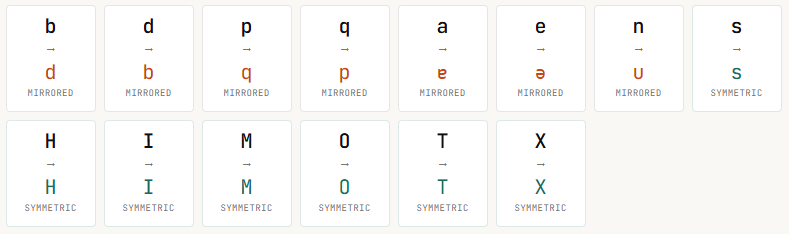
- Mirrored letters: Each character is replaced with its horizontally flipped Unicode equivalent. ‘b’ becomes ‘d’, ‘p’ becomes ‘q’. Letters like H, I, M, O, T, U, V, W, X, Y are symmetric and stay unchanged.
- Mirrored words: The full word order is reversed AND each letter is flipped, producing a complete mirror image of the word.
The word AMBULANCE is written in mirror text on the front of emergency vehicles so drivers read it correctly in their rear-view mirrors, one of the most practical real-world uses of mirror text.

Mirror Words and Letters
Mirror words and mirror letters are related but produce different results. Understanding the difference helps you choose the right output for your project.
Common Mirrored Letter Pairs
What are mirror words?
A mirror word is a complete word where every letter has been flipped AND the letter order reversed, the full mirror image as it would appear reflected. The word RACE mirrored becomes ƎƆAR.
How to Use Our Mirror Font Generator?
- Enter Your Text: Type or paste your text into the box provided. The tool automatically converts it into mirror text.
- Choose Horizontal or Vertical Mirroring: You can select between horizontal or vertical mirror text generation based on your preference. This allows you to create flipped text in a layout that suits your design or creative needs.
- Convert Button: Optionally, click the “Convert” button to manually mirror the text.
- Copy, Download, or Save: After converting your text into mirrored text or vertical text, you can copy it for use elsewhere, download it as a file, or save it in a Word document for easy editing and formatting. These options make it effortless to share and use your creations.
Horizontally and Vertically Mirroring Text
The tool supports both horizontal and vertical mirror text generation. Here is the difference:
| Horizontal mirror | Vertical mirror | |
| Flip axis | Vertical axis, left-right flip | Horizontal axis, top-bottom flip |
| Result | Text faces opposite direction, like a reflection | Text appears upside down |
| Common use | Vehicle markings, glass decals, transfer printing | Watermarks, banner designs, decorative typography |
| Example | HELLO → OꟷLLƎH | HELLO → ʜƎLLO (inverted) |
Practical Applications of Mirror Text
Mirror text has uses across creative, professional, and everyday contexts. Here are five of the most common:
Social Media Posts
Design and Print Projects
T-shirts, mugs, window decals, and transfer prints need horizontally flipped text — the printing process reverses the image. Generate reversed text here and skip multiple steps in your design workflow.
Privacy and Secure Notes
Mirror writing creates messages not immediately readable to a casual observer. Reversed text adds a basic visual layer of obscurity for personal notes, diary entries, or informal messages.
Fun Messages and Games
Mirror text messages are popular in group chats and social challenges. Send a message someone has to hold to a mirror to read, or use mirrored text in escape-room party games and scavenger hunts.
How Does the Mirror Text Generator Work?
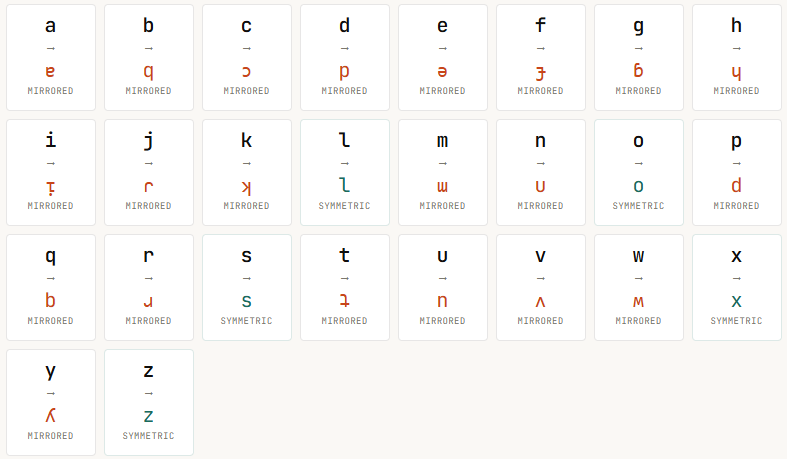
The generator substitutes each standard Latin letter with its Unicode mirror equivalent, sourced from Latin Small Letter Open O, Greek letters, Canadian Syllabics, and IPA phonetic symbols. Letters marked Symmetric are bilaterally identical when flipped and are rendered unchanged.
Fun Facts and Trivia
Mirror writing has some fascinating aspects and uses throughout history and pop culture. For example, Leonardo da Vinci famously wrote his notes in mirror writing, possibly to protect his ideas or avoid smudging the ink.
In movies and TV shows, mirror writing often appears as a mysterious or cryptic message. For example, the phrase “REDRUM” in The Shining is “MURDER” spelled backward and mirrored.
There’s even a mirror writing alphabet, used for fun or artistic purposes. It’s a unique way to present text, whether in art, puzzles, or secret codes.
FAQs
Microsoft Word does not have a dedicated ‘mirror text’ button, but you can achieve the effect in two ways:
- Insert a text box (Insert > Text Box). Type your text inside it.
- Right-click the text box and select ‘Format Shape.’
- Under ‘3-D Rotation,’ set the X rotation to 180 degrees for a horizontal mirror, or Y rotation to 180 degrees for a vertical mirror.
- Click OK. The text in the box will now appear mirrored.
Faster alternative: Use this Mirror Text Generator to create mirrored text, copy it, and paste it directly into your Word document as plain text. No formatting steps required and the mirrored Unicode characters work in Word without any rotation.
These terms are related but produce different results:
- Backwards text (also called reverse text) reverses the order of characters in a string. ‘HELLO’ becomes ‘OLLEH’. The letters themselves are not flipped only their sequence is reversed.
- Mirror text flips each individual character horizontally using its Unicode mirror equivalent, AND reverses the word order. ‘HELLO’ becomes ‘OꟷLLƎH’ each letter facing the opposite direction.
- Mirrored letters only: This option flips each letter in place without reversing the order. Useful when you want each character to appear reflected, but the reading direction to remain left-to-right.
This tool generates all three versions so you can choose the one that fits your purpose.
Yes. The tool supports both horizontal and vertical mirror text generation. Horizontal mirroring flips text left to right (as in a standard mirror reflection). Vertical mirroring flips text top to bottom, producing an upside-down effect. Select the ‘Vertical Mirror’ option before converting to generate vertically flipped output.
The easiest way to read mirror text is to hold the text up to a physical mirror, the reflection will show the original readable text. Alternatively, you can paste the mirrored text back into this tool: the generator will reverse the mirroring and return the original string. For digital images containing mirror text, many photo editing apps have a ‘flip horizontal’ function that reverses the mirroring visually.
Letters that are bilaterally symmetric along a vertical axis look identical when flipped horizontally. These are sometimes called ambigrams or symmetric letters. In the standard Latin alphabet, the naturally symmetric capital letters are:
A, H, I, M, O, T, U, V, W, X, Y
Lowercase letters with natural symmetry include: i, l, o, v, w, x.
All other letters have an asymmetric shape and will appear as a different (or modified) character when mirrored. This is why a mirrored ‘b’ looks like a ‘d’, and a mirrored ‘p’ looks like a ‘q’.
Leonardo Da Vinci wrote the majority of his personal notebooks, containing anatomical studies, engineering sketches, and scientific observations, in mirror script, running from right to left across the page. Historians and cognitive scientists have proposed several explanations:
- Da Vinci was left-handed. Writing right-to-left with the left hand is more natural and avoids smudging wet ink across the page.
- Deliberate secrecy: Mirror writing made his notes harder for casual readers to decipher, which may have protected his ideas from competitors or the church during a period of scientific censorship.
- Some researchers suggest it was simply a habit he developed in childhood and maintained throughout his life.
Da Vinci’s mirror-written manuscripts are held by institutions including the Royal Library at Windsor Castle and the Bibliothèque de l’Institut de France. His use of mirror writing is one of the most documented historical examples of practical mirror text.
This tool generates Unicode-based mirror text, mirrored characters that can be copied and pasted as plain text into any application. For a visual mirror image of text rendered as an actual image (JPG, PNG), you would need an image editing tool like Canva, Adobe Photoshop, or GIMP, which have built-in ‘flip horizontal’ or ‘mirror’ functions under their Transform or Edit menus.
However, for most practical uses — social media captions, Word documents, design mockups with text layers, Google Slides — the Unicode mirror text from this generator works without converting it to an image.
Mirror writing, particularly reversing individual letters like b/d or writing words backwards, is common in children aged 3 to 7 years and is a normal part of early literacy development. Most children grow out of it as their reading and writing skills develop.
In older children and adults, persistent mirror writing can sometimes be associated with dyslexia or other learning differences, but it is not a standalone diagnostic criterion. Dyslexia is diagnosed through a comprehensive assessment by a qualified educational psychologist or learning specialist, not through handwriting patterns alone.
If you have concerns about a child’s writing development, a consultation with a speech-language pathologist or educational specialist is the appropriate first step.